For the animal shall not be measured by man. In a world older and more complete than ours, they move finished and complete, gifted with extensions of the senses we have lost or never attained, living by voices we shall never hear. They are not brethren, they are not underlings; they are other nations, caught with ourselves in the net of life and time, fellow prisoners of the splendour and travail of the earth.
From The Outermost House by Henry Beston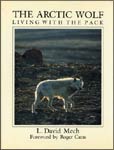 "It was the highlight of my life. Hundreds of miles north of Hudson Bay, a thousand or more from the nearest city, I stood alone in the High Arctic – surrounded by wolves." Thus begins Dave Mech's account in his book The Arctic Wolf – Living with the Pack of what he called his lifetime dream – to travel to Ellesmere, one of the huge islands that lies between the north edge of the continent and the North Pole, and study the wolves that live in this remote and harsh environment where humans have not established any permanent habitations.
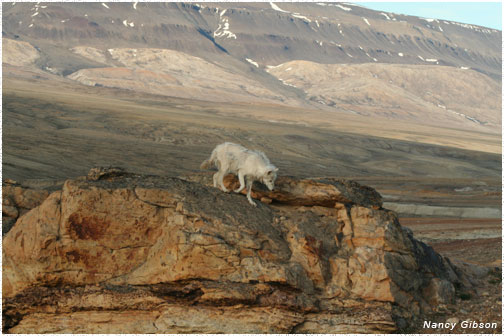
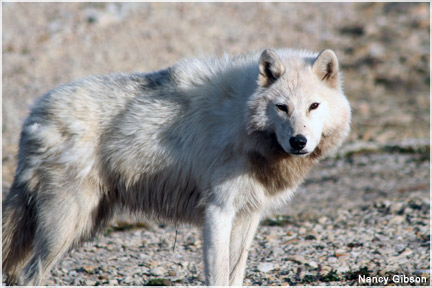
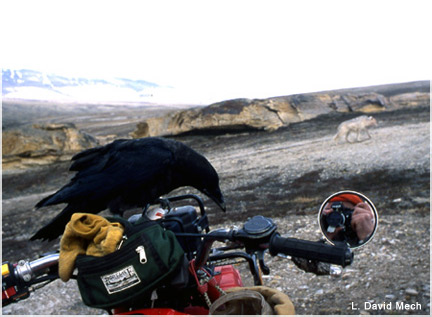
Because the wolves of the high arctic have never been harassed or persecuted by humans, they are not secretive and afraid of people the way wolves are in the southern latitudes. Thus, for 20 summers, Dave Mech has been granted a research permit from the territorial government in Canada and has been able to observe the wolves for weeks at a time, traveling with them, watching them hunt their natural prey and recording their behavior as they rear their pups and interact with one another as a family unit. Over the course of 20 years, he has seen the prey populations flourish and wane and bound back again. The wolf numbers fluctuate, too. Some years the pack is large – several adults and numerous offspring. Other years, only 1 pup is produced - or none. And sometimes there are no wolves at all to be found.
In the summer of 2006, three International Wolf Center board members, Nancy Gibson, Cornelia Hutt and Ted Spaulding, accompanied Dave on his annual expedition to Ellesmere Island. He was able to secure the requisite permits for the three to be informal members of his team, and all sponsored themselves on the trip.
 This journal serves two purposes. The first is personal. It is a record of an unforgettable odyssey to a place few people go. Moreover, it is an attempt to preserve images and events that will forever be a part of each of us, to be nurtured and reflected upon every day of our lives. The second is more encompassing. The journal is a celebration of 20 years and countless hours of research and data collection which have served not only science but the general public as well. Dave Mech wrote that he hoped he could “. . .help other people to see the wolf for what it is: one more magnificent species, superbly adapted to contend with its harsh environment, and highly deserving of our understanding and acceptance.” He has succeeded far beyond his expectations and his hopes.
Photography by Nancy Gibson and L. David Mech.
Scroll to the bottom of this blog to begin reading the daily journal of this unforgettable odyssey.
 “A big part of the island’s magic for me is the sense I get from the landscape. It is as if the glaciers recently left, and all sorts of life forms are moving in to occupy the newly available habitat. It’s also about the fossils that reminded me of the remarkable story of an environment long ago that was very different from what is there today. I half expected to see a mastodon come round one of the hills. It is life at the edge . . . so hardy and diverse, yet so vulnerable to the extreme conditions.”
A Reflection on Ellesmere Island
Summer of 2005
Walter Medwid, Executive Director
International Wolf Center
The Last Day – (Day 14)We pack up. Our charter flight back to Resolute Bay will arrive at 10:00 the next morning. The weather is good, so there is no reason to think the flight will be delayed. Edgar hangs around, but the mystery of where he came from remains. He has become a virtual mascot at the weather station, however, and the staff will take care of him through the long dark winter.
We head for the den to say our farewells. Life will go on for the wolf pack – the pups and Mother and Brutus, Grayback and Dirt Ball, Redneck and Bottle Brush and Gimpy. Leaving them is terribly hard, but it is good to know they are healthy and thriving. Maybe they will be here next summer when Dave returns to continue his study of the wolves of the High Arctic and to share his discoveries with the scientific community and the general public as well.
Day 13 And he is! Just before noon, there is Edgar fussing and croaking and strutting around. We are ecstatic. Nancy has raised birds, and she reminds us that baby birds are quickly imprinted by the first thing they see when their eyes open. Whatever that is becomes their “mother,” and they follow it relentlessly. Perhaps Edgar’s first visual impression was a human. It’s a bit of a leap to say Edgar thinks he is a person, but it’s tempting to suppose that he does!
Blacktop Ridge – (Day 12)
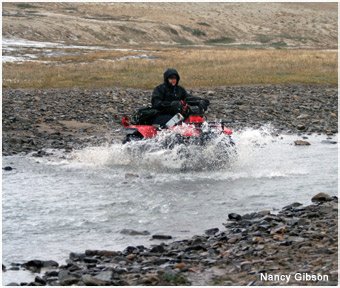
After breakfast, we head for Blacktop. It looks much closer than it is. It takes us fully 2 hours of bouncing along, splashing back and forth through Blacktop Creek as Dave scouts for a safe route. “This is spectacular,” I say, and it is. “The best is yet to come,” Dave replies. He’s right. At the base of Blacktop is a narrow valley between two sheer rock walls that remind me of the descent into the Grand Canyon on the Colorado River. The valley floor is a wonderland of cotton grass dotted with wildflowers of every color. It is pure enchantment, another place on Ellesmere touched with magic. We unload the quads and climb a steep hill, settling on the flank of the ridge to scan for herds of musk oxen. The wind is fierce, and the sky boils with dark clouds.
We retrace our route and wait until 8:00 before heading to the den. The rain stops, and we start the long trek out to the den where Bottle Brush and Grayback, the nannies on duty, take turns entertaining the pups and playing with them.
Edgar Comes Home
It is very late when we head back - early morning, if one goes by clock time. Pausing on a ridgeline to rest, we glance back, and what to our wondering eyes should appear but a miniature black speck in the distant sky. You guessed it. It’s Edgar. He sails in for a landing beside us, looking deeply offended and put out with all of us. We head back in stages, pausing every so often to let Edgar get over his fits of pique and catch up. Eventually he strays off into the sparse underbrush and obstinately refuses to come farther. But we console ourselves with the certainty that he knows how to find us. Nonetheless, we sound like grumbling parents complaining about a teenager who is late coming home. "He'll be here later!" we reassure one another.

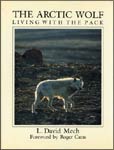 "It was the highlight of my life. Hundreds of miles north of Hudson Bay, a thousand or more from the nearest city, I stood alone in the High Arctic – surrounded by wolves." Thus begins Dave Mech's account in his book The Arctic Wolf – Living with the Pack of what he called his lifetime dream – to travel to Ellesmere, one of the huge islands that lies between the north edge of the continent and the North Pole, and study the wolves that live in this remote and harsh environment where humans have not established any permanent habitations.
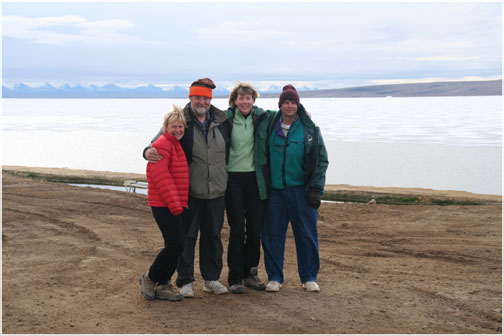 This journal serves two purposes. The first is personal. It is a record of an unforgettable odyssey to a place few people go. Moreover, it is an attempt to preserve images and events that will forever be a part of each of us, to be nurtured and reflected upon every day of our lives. The second is more encompassing. The journal is a celebration of 20 years and countless hours of research and data collection which have served not only science but the general public as well. Dave Mech wrote that he hoped he could “. . .help other people to see the wolf for what it is: one more magnificent species, superbly adapted to contend with its harsh environment, and highly deserving of our understanding and acceptance.” He has succeeded far beyond his expectations and his hopes.